Posts tagged technology and change
 Gotham’s bike boom

In a metropolis known for its aggressive traffic, noise and fumes, cyclists crisscross New York City on two wheels while dodging cars, trucks, cabs, pedestrians—and even other bikers tearing around with no hands on the bar.
Despite the dangers, biking is New York City’s “fastest growing mode of transportation,” says City Transportation Commissioner Janette Sadik-Khan, who herself bikes to work in lower Manhattan, about a mile from her Greenwich Village home.
The number of cyclists has jumped by 80 percent in the past decade—to 185,000 among the more than 8 million city denizens. City officials say they’ve worked to make the city more biker friendly. They note the hundreds of miles of marked bike paths created in recent years, safety awareness campaigns and handouts of free helmets to unprotected cyclists.


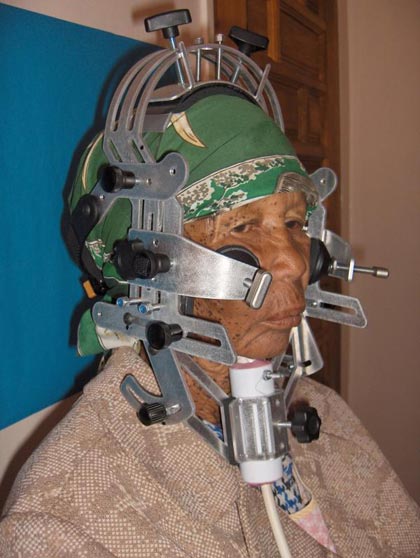
I know the Amish, and Wendell Berry and Eric Brende, and the minimites well enough to know that they believe we don’t need exploding technology to expand ourselves, at least in the proper directions. They are, after all, minimalists. They see most of the promises of freedoms from increased technology as illusionary. In their eyes, technology generates fake choices, meaningless options, or real choices that are really entrapments. This is an argument worth exploring because there is some truth in it. The technium is an autonomous system that tends to favor choices by humans that expand its own reach, which can feel like a type of entrapment. And many choices we make don’t matter.
But the evidence that the technium expands real choices is voluminous. Throughout history there is a one-way march from the farm to the bustling choices of the city. That steady migration is going on today at a shocking rate; More than two million people per day decide they prefer the options that modern technology life offers, so they flee the constrained choices in a picturesque and comforting village somewhere. They can’t all be bewitched. It would be a powerful spell to fool 50% of the people living on this planet.
Those million urban migrants per day have enrolled into the technium for the same reason you have (and you have if you are reading this): to increase your choices. To increase your chances of unleashing your full potential. Perhaps someday someone will invent a tool that is made just for your special combination of hidden talents. Or perhaps you will make your own tool. Most importantly, and unlike the Amish and minimites, you may invent a tool which will help unleash the fullest of someone else. Our call is not only to discover our fullest selves in the technium, but to expand the possibilities for others. We have a moral obligation to increase the amount of technology in the world in order to increase the number of possibilities for the most people. Greater technology will selfishly unleash us, but it will also unselfishly unleash others, our children and all to come.
 File sharing

Yes, an exclusive Sufjan Stevens track, “The Lonely Man of Winter!” The catch? The only way you’re going to hear it is to get into the living room of Brooklynite Alec Duffy’s Prospect Heights apartment. Duffy won exclusive rights to the song via Sufjan’s 2007 contest– and rather than uploading it to the web, he decided that the song would be exclusively played in his apartment.
Fans come from near and far, taking subways or timing flights to New York City to attend listening sessions. They walk through a corridor strewn with strollers to get to his corner apartment in Brooklyn’s Prospect Heights. Since January, when he started the sessions, Mr. Duffy says about 60 people have come to his place to hear the tune, called “The Lonely Man of Winter.”

What the great moment in the Ether Dome really marked was something less tangible but far more significant: a huge cultural shift in the idea of pain. Operating under anesthetic would transform medicine, dramatically expanding the scope of what doctors were able to accomplish. What needed to change first wasn’t the technology - that was long since established - but medicine’s readiness to use it.
Before 1846, the vast majority of religious and medical opinion held that pain was inseparable from sensation in general, and thus from life itself. Though the idea of pain as necessary may seem primitive and brutal to us today, it lingers in certain corners of healthcare, such as obstetrics and childbirth, where epidurals and caesarean sections still carry the taint of moral opprobrium. In the early 19th century, doctors interested in the pain-relieving properties of ether and nitrous oxide were characterized as cranks and profiteers. The case against them was not merely practical, but moral: They were seen as seeking to exploit their patients’ base and cowardly instincts. Furthermore, by whipping up the fear of operations, they were frightening others away from surgery and damaging public health.
The “eureka moment” of anesthesia, like the seemingly sudden arrival of many new technologies, was not so much a moment of discovery as a moment of recognition: a tipping point when society decided that old attitudes needed to be overthrown. It was a social revolution as much as a medical one: a crucial breakthrough not only for modern medicine, but for modernity itself. It required not simply new science, but a radical change in how we saw ourselves.
Looks like work
Anyone who has followed fantasy football or an eBay auction at the office — and gotten away with it — knows that many of our everyday activities now look like work. Typing and scrolling and peering at a computer, you could be doing anything: e-mail, accounting, short-selling, browsing porn, buying uranium, getting divorced.
This odd accident of life online — the increasing visual homogeneity of our behaviors — may be a boon to procrastinators, hobbyists and multitaskers. But it has some victims. I don’t mean bosses concerned with productivity (who cares about them?). The crowd truly stymied by the merging of human activities are filmmakers. If fighting now looks like making up now looks like booking travel, as it does when people conduct their affairs online, how do film directors make human action both dramatic to viewers and roughly true to life?
Eat when you eat
The dominant revenue model of the web today—the ad that urges a click—embeds distraction into interface design. The more clicks you take—the more Google makes in ad revenue (distraction pays). This is not to say that social media doesn’t have extraordinary value—it does. It is at the heart the emerging social nervous system. Yet, the ability to pay attention, focus and strategically disconnect will be a winning discipline of the next generation of business leaders. As the zen phrase says, “eat when you eat” meaning, give each thing you do all of your attention.
The rise in texting is too recent to have produced any conclusive data on health effects. But Sherry Turkle, a psychologist who is director of the Initiative on Technology and Self at the Massachusetts Institute of Technology and who has studied texting among teenagers in the Boston area for three years, said it might be causing a shift in the way adolescents develop.
“Among the jobs of adolescence are to separate from your parents, and to find the peace and quiet to become the person you decide you want to be,” she said. “Texting hits directly at both those jobs.”
Psychologists expect to see teenagers break free from their parents as they grow into autonomous adults, Professor Turkle went on, “but if technology makes something like staying in touch very, very easy, that’s harder to do; now you have adolescents who are texting their mothers 15 times a day, asking things like, ‘Should I get the red shoes or the blue shoes?’”
Auto-Tune and the cyborg embrace
Vocal runs that would sound bizarre without Auto-Tune have become necessary to create some now-common effects. The plug-in facilitates something analogous to a human-machine duet. Raskin has recorded with countless major vocalists, including best-selling rapper Lil Wayne. He says that, ‘99 per cent of all pop music has corrective Auto-Tuning.’ But when artists flamboyantly foreground its use, they sing and simultaneously listen to themselves being processed. Lil Wayne records with Auto-Tune on – no untreated vocal version exists. In an era of powerful computers that allow one to audition all manner of effects on vocals after the recording session, recording direct with Auto-Tune means full commitment. There is no longer an original ‘naked’ version. This is a cyborg embrace. In Cyborg Manifesto (1991), Donna Haraway notes that ‘the relation between organism and machine has been a border war.’ Auto-Tune’s creative deployment is fully compatible with her ‘argument for pleasure in the confusion of boundaries and for responsibility in their construction.’


Two schools I have taught at in the past couple of years ban camera use at their high school musical night. One of the reasons is because students look out to the audience to see if mum and dad are watching. If they see only a sea of lenses instead of adoring eyes they are met with technology rather than soul.
We are obsessed with recording life from our point of view, even when it is only 30 cm from the next person’s POV.
The Mona Lisa is photographed by every visitor to the Lourve when we have ready access to pristine images of her taken in optimum lighting etc.
We humans are strange creatures.
Babel undone
Nate
:So the LORD scattered them from there over all the earth, and they stopped building the city. That is why it was called Babel —because there the LORD confused the language of the whole world. From there the LORD scattered them over the face of the whole earth.
English–Albanian–Arabic–Bulgarian–Catalan–Chinese–Croatian–Czech–Danish–Dutch–Estonian–Filipino–Finnish–French–Galician–German–Greek–Hebrew–Hindi–Hungarian–Indonesian–Italian–Japanese–Korean–Latvian–Lithuanian–Maltese–Norwegian–Polish–Portuguese–Romanian–Russian–Serbian–Slovak–Slovenian–Spanish–Swedish–Thai–Turkish–Ukrainian–Vietnamese–English
Then stop developing city and region. Yes, more than one world language. Reverse direction in this area.
Nate
:Poking Facebook
Nate
:Six of my nieces will head off to college over the next several years. Some have been Facebooking since middle school. Even as they leave home, then, they will hang onto that “home” button. That’s hard for me to imagine. As a survivor of the postage-stamp era, college was my big chance to doff the roles in my family and community that I had outgrown, to reinvent myself, to get busy with the embarrassing, exciting, muddy, wonderful work of creating an adult identity. Can you really do that with your 450 closest friends watching, all tweeting to affirm ad nauseam your present self? The cultural icons of my girlhood were Mary Richards of “The Mary Tyler Moore Show” and Ann Marie of “That Girl,” both redoubtably trying to make it on their own. Following their lead, I swaggered off to college (where I knew no one) without looking back; then to New York City (where I knew no one) and San Francisco (ditto), refining my adult self with each jump. Certainly, I kept in touch with a few true old friends, but no one else — thank goodness! — witnessed the many and spectacular metaphoric pratfalls I took on the way to figuring out what and whom I wanted to be. Even now, time bends when I open Facebook: it’s as if I’m simultaneously a journalist/wife/mother in Berkeley and the goofy girl I left behind in Minneapolis. Could I have become the former if I had remained perpetually tethered to the latter?
Bring the noise
Nate
:[Stanford music professor Jonathan] Berger then said that he tests his incoming students each year in a similar way. He has them listen to a variety of recordings which use different formats from MP3 to ones of much higher quality. He described the results with some disappointment and frustration, as a music lover might, that each year the preference for music in MP3 format rises. In other words, students prefer the quality of that kind of sound over the sound of music of much higher quality. He said that they seemed to prefer “sizzle sounds” that MP3s bring to music. It is a sound they are familiar with…
Our perception changes and we become attuned to what we like [...] The context changes our perception, particularly when it’s so obviously and immediately shared by others. Listening to music on your iPod is not about the sound quality of the music, and it’s more than the convenience of listening to music on the move. It’s that so many people are doing it, and you are in the middle of all this, and all of that colors your perception. All that sizzle is a cultural artifact and a tie that binds us. It’s mostly invisible to us but it is something future generations looking back might find curious because these preferences won’t be obvious to them.
Making things that we can touch
Nate
:We’ve been using “Minority Report” as shorthand to explain the device, or the heads-up screen in “Robocop.” But was this device influenced by science fiction
I’m not a very big fan of science fiction. I think that I’m a very big fan of living in the physical world. I’m good with digital technology, but I start to miss the physical world. I miss riding my bike, talking to friends. Technology now separates us from the physical world more and more. Even social networking sites are taking us away from the physical world.
At the lab, we like making things that we can touch, we can feel, we can take with us wherever we want to go, that we know how to interact with. The digital world has power because it has dynamic information, but it’s important that we stay human instead of being another machine sitting in front of a machine.
Whatever science fiction movies we watch now, we can make the technology real in two days. What we can do is not important. What we should do is more important.
A dirge revival
Nate
:
Speaking of parting, it is only rarely that dirges are heard in Kawu nowadays. Two factors are contributing to their decline: firstly the fact that many churches discourage their use, preferring edifying hymns instead. The reason behind this, I am told, is that the dirges reflect a pre-Christian worldview and as such are to be eschewed by true Christians. A second factor has been the coming of electricity to the villages halfway the nineties, which has led to loud music taking the place of the dirges during the wakekeepings. Elsewhere I wrote that “culture is a moving target, always renewing and reshaping itself”, yet at the same time I can’t help but lament the imminent loss of such a rich vein of Mawu culture.
However, during my last fieldtrip there were some signs of a renewed interest in the genre. For example, one pastor told me that he had been reconsidering the rash dismissal of the dirges by his church. Realizing how important the dirges had been in containing, orienting, and canalizing the feelings of loss and pathos surrounding death, he felt that the Christian hymns did not always offer an appropriate replacement. Another hopeful event was that I was approached with the request to help record a great number of dirges in Akpafu-Todzi in August 2008. This was not just to record them for posterity (although this was part of the motivation), but also very practically so that they could be played at wakekeepings. I gladly complied with this wish of course. The result is a beautiful collection of 42 dirges, sung by eight ladies between 57 and 87 years of age. The first time the dirges were played at a funeral they sparked a wave of interest.
 The Plastics Inventor
Nate
: